Health and Medicine
 13
13




When you see a chainsaw hacking down a tree, the thought probably furthest from your mind is "I bet that would work well for childbirth". Well, get ready to think that forevermore, because it turns out that chainsaws were genuinely first designed for hacking away at genitals, before being applied to oak.
The rest of this article is behind a paywall. Please sign in or subscribe to access the full content.Chainsaws and childbirth
The rumors on social media are true: the chainsaw was originally invented as a "tool" to aid childbirth.
It was in an operation known as a symphysiotomy, a risky and grossly outdated surgical procedure in which the cartilage between the left and right pelvic bone was severed, widening the pelvis and allowing childbirth.
Childbirth may not always be easy today, but in a time before nitrous oxide, sanitation, and our good friend copious amounts of morphine, it was significantly worse. The first written record we have of a successful cesarian section (C-section) comes from Switzerland in the 1500s, performed by a professional cow-castrator on his wife. According to the account – written 82 years later and disputed by some historians – the mother and child survived, with the baby living to be 77 years old.
The first published account of C-sections in the US meanwhile is far more horrific. In an 1830 edition of the Western Journal of Medical and Physical Sciences, Dr John L. Richmond described the case of a difficult birth during a storm.
After many hours, with labor failing to progress, the doctor believed the woman's life to be in grave danger and “feeling a deep and solemn sense of my responsibility, with only a case of common pocket instruments, about one o'clock that night, I commenced the Caesarean Section."
Using the blade of a crooked pair of scissors, he cut into the mother and attempted to remove the fetus. However, "as it was uncommonly large, and the mother very fat, and having no assistance, I found this part of my operation more difficult than I had anticipated," he wrote. With the mother in too much agony, he decided that "a childless mother was better than a motherless child" and set about saving the mother and removing the fetus.
This is all to illustrate that before antiseptics and anesthetics in medicine, C-sections were extremely high-risk and thus rare.
Why chainsaws were invented
Far more common, from 1597 until when C-sections became safe, was a surgical procedure known as a symphysiotomy, in which the pubic symphysis – a joint made of cartilage above the vulva – is cut to widen the pelvis and make childbirth go more smoothly.
Like all surgical procedures of the time, it wasn't without risk, and speed was of the essence. The less time spent operating, the less likely the patient would go into shock or develop a deadly infection.
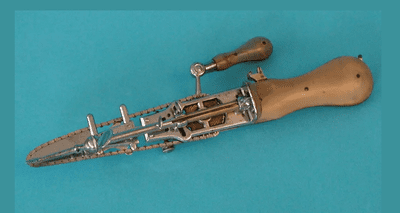
In the late 18th century, two Scottish doctors, John Aitken and James Jeffray, came up with a solution for getting the job done much more quickly and efficiently: an actual chainsaw for the groin. The world's first chainsaw was a flexible saw based on a watch chain with teeth that were moved around with a hand crank.
Now, rather than look down and see a doctor cutting away at your pelvis, you could look down and see the far more reassuring sight of a doctor furiously cranking a chainsaw like they were sharpening a pencil.
The truly horrific part of this is that somebody going to town on your nether regions with a chainsaw was actually a vast improvement. The device, finally produced in 1806, went on to be used for removing diseased joints and was eventually mechanized.
It wasn't until 1905 that somebody thought of this horror device and decided to apply it to trees, revolutionizing the logging industry with its efficiency and power.
If you're in the mood for more chainsaw trivia, check out the world's largest chainsaw. Big Gus, built by Moran Iron Works in Michigan, holds the record at a massive 6.98 meters (22 feet 11 inches) long. It's fully functional – but thankfully, it's only used for cutting inanimate objects, not people.