Nature
 PUBLISHED
 5
5


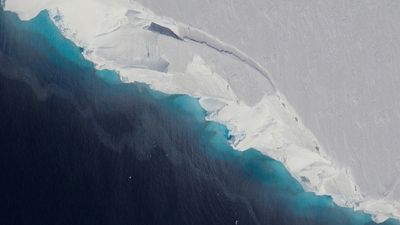


The Thwaites glacier in Antarctica – known as the "doomsday glacier" because of its high risk of collapse – is “holding on today by its fingernails,” according to a new survey.
Marine geophysicists have recently carried out the first-ever high-resolution mapping of the seafloor in front of the Thwaites glacier, a chunk of ice on the edge of West Antarctica roughly the size of Florida, to understand its movements in the pre-satellite era.
The new study found that the glacier’s base dislodged from the seabed and, at some point in the last 200 years, retreated at a rate of 2.1 kilometers (1.3 miles) per year in the space of six months. That’s double the rate documented using satellites in the last decade or so.
The research was published this week in the journal Nature GeoSciences.
This observation challenges the old assumption that Antarctic glaciers are relatively slow to respond to change. Once we add the new threat of climate change into the mix, it appears that the Thwaites glacier could be much more prone to rapid retreats than previously thought. As the study notes: “similar rapid retreat pulses are likely to occur in the near future.”
“Our results suggest that pulses of very rapid retreat have occurred at Thwaites Glacier in the last two centuries, and possibly as recently as the mid-20th Century,” Alastair Graham, lead study author from the University of South Florida’s College of Marine Science, said in a statement.
“Just a small kick to Thwaites could lead to a big response,” he added.
The Thwaites glacier is sensationally known as the "doomsday glacier" as it holds back enough ice to raise sea level up to a meter (over 3 feet). If it totally collapses through a rapid retreat, that could mean real trouble in terms of sea level rise.
Many recent studies have shown that this vital body of ice is in a worrying situation. In 2020, a study argued that the Thwaites glacier appears to be becoming even more unstable the more it retreats. One estimate from 2021 suggests that much of the glacier will collapse within just five years.
This latest study further highlights the glacier underwent rapid retreats in the past and we should anticipate seeing much of the same in the years ahead.
“Thwaites is really holding on today by its fingernails, and we should expect to see big changes over small timescales in the future – even from one year to the next – once the glacier retreats beyond a shallow ridge in its bed,” explained Robert Larter, marine geophysicist and study co-author from the British Antarctic Survey.