Space and Physics
 PUBLISHED
 2
2



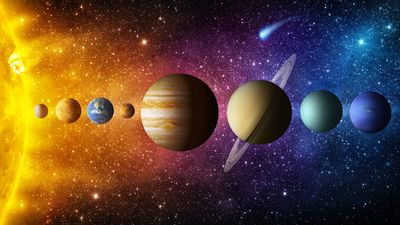


Have you ever wondered how fast the planets are compared to each other? A fantastic animation by astronomer Dr James O'Donoghue shows very clearly which of the eight planets moves through space the fastest, and given the winner, it has to.
Yes, the speediest is Mercury! The smallest planet is the closest to the Sun, so it also reaches the highest speed to escape the gravitational pull. Orbital speed is inversely proportional to the square root of the distance. So the closer you are to the big gravitational object you orbit, the faster you get to go.
The same happens in any orbiting system. The fastest moon in the Solar System is Metis, the innermost Moon of Jupiter, which moves at about 31.5 kilometers (19.6 miles) per second. Another example is asteroid 2021 PH27, which gets closer to the Sun than Mercury and is the fastest asteroid known.
Aside from creating incredible animations that help us understand the Solar System a little better, Dr O’Donoghue’s expertise is on the rings of Saturn. In the Twitter thread, he explained the thin but vast structures made of icy particles actually move at different speeds and how, due to interactions with the atmosphere of the ringed planet, the innermost ring is being destroyed. While that doesn’t happen constantly, O’Donoghue and colleagues have been studying a phenomenon known as "ring rain".