Space and Physics
 PUBLISHED


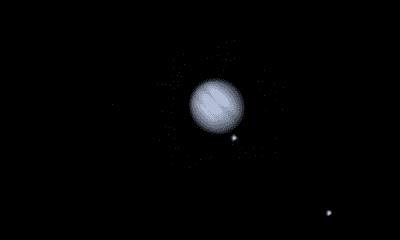


Both Jupiter and NASA’s DART mission have been in the news a lot this week as they are both having a bit of a moment. Jupiter is set for its closest meeting with Earth since 1963 next week and DART, on its way to its own date with destiny, snapped a gorgeous image of the gas giant as it went by.
As the world's first planetary defense test mission continues on its way to collide with its target – asteroid Didymos’s moonlet Dimorphos – on September 26, it’s been testing out a vital instrument: its onboard camera, the Didymos Reconnaissance and Asteroid Camera for Optical navigation, or DRACO.
DRACO is the only instrument on DART, and will be capturing all of the action as the spacecraft hits the moonlet, sending us back photos of the collision and aftermath. To test out its smart navigation system, the team on the ground at the Johns Hopkins Applied Physics Laboratory (APL) turned it towards Jupiter, seeking out the gas giant’s moon Europa.
Europa is one of Jupiter’s four largest moons, known as the Galilean moons – Io, Europa, Ganymede, and Callisto. Europa is actually the smallest and they set the SMART nav to detect it as it emerged from behind Jupiter just as Dimorphos will visually separate from Didymos as DART gets closer.

With Jupiter and its moons, the team could study how the number of pixels of different objects might vary as the targets move across the detector.
“The Jupiter tests gave us the opportunity for DRACO to image something in our own Solar System,” said Carolyn Ernst, DRACO instrument scientist at APL in a statement. “The images look fantastic, and we are excited for what DRACO will reveal about Didymos and Dimorphos in the hours and minutes leading up to impact!”
The composite image was taken when DART was approximately 26 million kilometers (16 million miles) from Earth and Jupiter was 700 million kilometers (435 million miles) away from the spacecraft.
It's unclear how soon we will get images of the collision next week but we’ve already had the probe's first view of Didymos, which is roughly 780 meters wide (2,560 feet) across. DART has also released LICIAcube, a secondary spacecraft from the Italian Space Agency, which also has a camera to image the impact and document the effect of DART on Dimorphus once it slams into it.