


 Space and Physics
 PUBLISHED
 18
18




Astronomers are poised to watch an artificial impact on the Moon, in a collision that is expected to leave a 20-30-meter (66–98-foot) crater on the lunar surface. As well as professional astronomers wishing to study the impact and resulting debris, amateur astronomers may be able to view it, though it will take a little timing, planning, and luck.
In the past, we have witnessed other objects impacting the Moon, with around 100 ping pong ball-sized impactors hitting our favorite satellite every day.
A rarer type of impact is one we have caused ourselves – not due to our gravity, but due to us sending a big chunk of metal (and other materials) on a collision course with the Moon.
On August 5, 2026, we will have the chance to witness this type of impact, courtesy of a SpaceX Falcon 9 rocket that was "abandoned in a Moon-crossing high-Earth orbit", according to a new paper.
The upper stage of the Falcon 9 was initially used to boost Firefly’s Blue Ghost-1 and the ispace Hakuto-R Resilience landers to the Moon last year. Whilst those missions were of mixed success, with contact being lost with the Resilience lander while Blue Ghost-1 nailed its landing, it appears there will be a third, unexpected landing on the Moon.
"With its work done, the rocket lacked the fuel to return to Earth or move into deep space," Gregory Radisic, Fellow at the Centre for Space, Cyberspace and Data Law at Bond University, explained in a piece for The Conversation. "It remained in an unstable orbit until gravity finally set it on a collision course with the lunar surface."
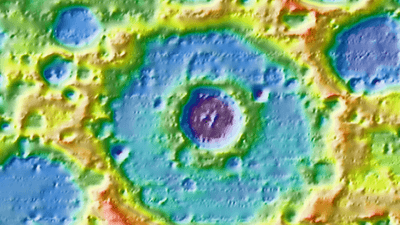
In May 2026, astronomers noted that the upper stage of the Falcon 9 was on course to slam into the Moon, with current predictions suggesting that it will touch down hard somewhere near Einstein crater on the Moon's western edge.
According to a new paper, the resulting impact will hit with a kinetic energy of 11.8 gigajoules and a momentum of 9.7 meganewtons. To put that in more helpful terms, when it hits it will do so with the energy of around 2.8 metric tons of TNT. To put that in much less helpful terms, that's around 2,820,267,686 calories.
The Moon will not eat the rocket stage. Instead, the debris will hit the Moon and create a sizable crater, whilst kicking up a lot of material and scattering it around the already quite dusty lunar landscape.
The crater is expected to be small, and will likely only be visible to orbiters around the Moon. Having said that, it will still be pretty spectacular.
"Laterally, modelling suggests that the ejecta blanket should be continuous over an area around 70 m in diameter centred on the crater," the team writes in their paper, which has not yet been peer reviewed.
"This presents a large target region in which fresh material will be excavated and may be imaged by subsequent spacecraft flyovers. This will be particularly advantageous for understanding the composition of the target material. The maximum ballistic range of resolved particles is found to be slightly under 1,000 km [621 miles], which is far enough to be significant from the perspective of presenting a hazard to future astronauts or infrastructure across much of the lunar surface."
While the resulting crater may only be seen by lunar orbiters, its possible we may see the impact from Earth, as well as space-based telescopes.
That's not a given. In fact, we have not seen a natural or artificial impact on the Moon's lit up side to date. On top of that, natural impactors, which can produce bright flashes on the Moon, tend to be moving a lot faster than this particular piece of space junk.
"Modelling and laboratory studies indicate that flash brightness decreases nonlinearly with impact velocity, making slow space debris impacts disproportionately dim as compared to faster natural impactors," the study's authors explain.
"This is because the visual magnitude of the flash decreases significantly once the impactor’s velocity is lower than the speed of sound in the target material – natural meteoroids all produce supersonic (shock)waves in all lunar materials, but space debris moving at ∼2 km/s will only produce a shockwave if the impact is into regolith (sound speed ∼ hundreds of metres per second) rather than bedrock (1000-2000 m/s)."
Nevertheless, artificial impacts have an obvious advantage that may make the impact flash and subsequent ejection of material easier to track: we know (roughly) when and where it is going to hit, and can point our telescopes at the area and watch closely.
If you would like to look for it yourself, the team suggests that it will be best visible at 06:35 UTC. It will also be easier to see (if it is visible at all) for people in South America and low-middle North America, where the darkness will help visibility.
However, the reason to get excited about this is more what we can learn from it. This is not the first artificial impact to hit the Moon, with NASA attempting it deliberately a few decades ago.
"NASA's Lunar Crater Observation and Sensing Satellite (LCROSS) was launched with the Lunar Reconnaissance Orbiter to determine if water-ice exists in a permanently shadowed crater at the Moon's south pole. As planned, LCROSS and its Centaur stage impacted the Moon on Oct. 9, 2009," NASA explains, adding that the impact revealed material which may not have seen sunlight for perhaps even billions of years.
"LCROSS and LRO found evidence that the lunar soil in shadowy craters is rich in useful materials, and that the Moon is chemically active and has a water cycle. Scientists also confirmed the water was in the form of mostly pure ice crystals in some places."
This impact, though unplanned, gives us opportunities for further study, given that we know the mass and trajectory of the impactor.
"This event is an ideal opportunity to calibrate measurements of flash brightness and plume dynamics against a known event, should either be detected," the team concludes.
"This event also provides an opportunity to test pipelines for measuring flash properties to locate impact events seismically, and to better understand the multi-modal hazards posed to future lunar infrastructure and astronauts from space debris impacting the Moon."
With space getting more and more cluttered, we may see more of these artificial impacts, and perhaps have a few discussions around the rules of permanently altering our nearest neighbor by smacking our discarded spacecraft into it.
The study is posted to preprint server arXiv.


