Nature
 PUBLISHED


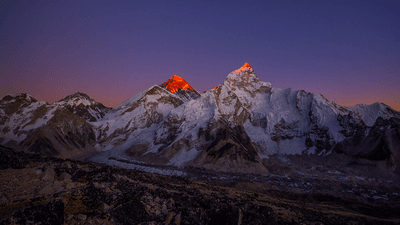


How tall is Mount Everest? That's actually a little bit of a controversial question, and one with several answers, depending on how you measure the world's highest mountain on Earth.
The rest of this article is behind a paywall. Please sign in or subscribe to access the full content.You have probably noted the unusual and awkward wording even in those first few sentences. This is because, whilst Everest's peak takes the title for being the highest point above sea-level, it is not the tallest.
If you measure mountains from base to peak, Mauna Kea in Hawai'i is the tallest on Earth, clocking in at 10,210 meters (33,500 feet), despite peeking out just 4,205 meters (13,796 feet) above average sea level. If we're talking the the furthest point on Earth from its center, that title goes to the 37th highest mountain in the Andes.
Everest has been scaled and measured many times over the years, with varying figures for its height. The first ever measurement of the mountain came in the mid-19th century, and was reported to the public as being 29,002 feet (8,840 meters). The interesting thing about this measurement, despite it being inaccurate by modern standards, is that the people reporting it knew it to be incorrect by their own standards.
“The first official survey of Everest took place in 1852. The surveyors took measurements in six places and derived an average figure of 29,000 ft," a paper on the topic explained. "This seemed too much like a round-number estimate for an official report, so they added 2 ft. to their published finding to make the height 29,002.”
This height was seen as the official measurement of Mount Everest for over a century, until the Survey of India in 1954 found it to be 8,848 meters (29,028 feet). This was reported accurately by the team, helpfully not being an exact round number when expressed in feet.
Mountain sizes can change, however, and we weren't done measuring Everest.
Because of the activity of the tectonic plate the Himalayas sit on, the heights of the mountains can change. Some geologists thought that a 2015 earthquake may have shrunk the ice cap on top of Everest, making the mountain a little smaller.
There is also some controversy over whether the ice cap should be included at all. Official Chinese measurements placed the mountain at around 8,844.43 meters (29,017.15 feet), lower than measurements by surveys from various countries around the world. This isn't down to crappy measurement, but because China preferred to not include the snow cap, instead favoring the "rock height".
Following the 2015 earthquake, a joint Nepal-China team surveyed the mountain, however, finding it to be 8,848.86 meters (29,032 feet), nearly a meter taller than it was during the last measurement, and ending the controversy about its height. Of course, this may be subject to change.