


 Space and Physics
 PUBLISHED


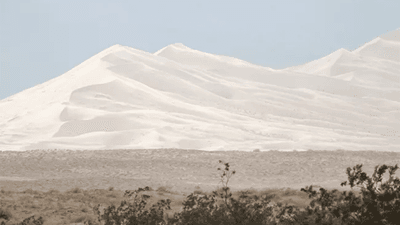


At various sandy deserts around the world, under the right circumstances, you can hear a variety of eerie noises, sometimes described as singing, whistling, barking, or screaming, depending on how dramatic you are feeling about the situation.
The rest of this article is behind a paywall. Please sign in or subscribe to access the full content.In ancient times, before modern explanations of it and the related "booming sand" phenomenon, it must have been especially creepy.
In the Tian Shan mountains of southeastern Kazakhstan, for example, a low-pitched rumble can sometimes be heard propagating across the landscape. Legend had it that the founder of the Mongol Empire and absolute killing machine Genghis Khan was buried beneath the dunes, and the noises heard by travelers were Khan attempting to recount his horrific victories to anyone passing by.
Another legend had it that "shaitan", or the devil, lay down to sleep there after being stripped of his satanic powers, and became the sand dune itself. According to that legend, he continues to rest there, but makes those horrific noises whenever he is disturbed.
Marco Polo, meanwhile, heard similar noises when traveling through dunes in China in the 13th century CE, describing it as "the sounds of all kinds of musical instruments," and "of drums and the clash of arms."
Whilst still quite eerie to listen to, in modern times we do at least have the comfort of knowing the cause behind it, though the mechanism still needs a little refining as always. Avalanches of sand, rather than Satan or Genghis Khan, are the main culprit behind the creepy whistling.
"The wind erodes the back of the dune and accumulates sand at the top of the slip face at the front. When the slope is too large, a spontaneous avalanche nucleates and propagates down the dune, and sound is produced," a paper that investigated the topic explains. "Artificial avalanches induced by sliding down the slip face have exactly the same acoustic emission: this proves that the sound is not due to the wind but directly to the grains motion."
"Whatever the size of the dune and the localization of the avalanche, we measured a frequency of [around 100 Hz], meaning that it is not controlled by a resonance involving the geometry of the whole slip face but by intrinsic properties of the grain dynamics within an avalanche."
That part is pretty weird, or at least very difficult to figure out. You might expect with all the chaos of colliding sand grains that you would hear a particularly sandy version of white noise, with all different notes clashing together. Instead, they can produce eerie, and surprisingly consistent notes, depending on the sizes of the grains involved.
In some dunes, scientists found that avalanches produced a low boom of around 100 Hz, around a G note or a G sharp, whilst others – most commonly, per Gizmodo – produce an A note of around 450 Hz quite consistently.
Conditions need to be just right for deserts to produce these consistent tones, with dry conditions being the most necessary aspect. As well as this, sand grains need to be of a consistent size, after many years of being ground down through collisions driven by the desert winds. There is still plenty to learn, however.
"It has been recognized that the sound is not due to the air flow around the dunes but to the motion of an avalanche, and not to an acoustic excitation of the grains but to their relative motion. By comparing singing dunes around the world and two controlled experiments, in the laboratory and the field, we prove that the frequency of the sound is the frequency of the relative motion of the sand grains," another paper adds.
"Sound is produced because moving grains synchronize their motions. The laboratory experiment shows that the dune is not needed for sound emission."
Despite being a very weird occurrence, singing deserts are surprisingly common. China is host to a number of them, as well as your classic example of a desert: the Sahara. Speaking to our largely US audience here, a more local singing dune can be found in California’s Mojave Desert, where you can play the desert like an instrument.
"Only seven known sand dune fields in North America produce booming, and the Kelso Dunes are one of them! It's a deep, eerie, rumbling sound you can feel in your bones; a rumbling vibration through your entire body," the National Park Service explains.
"The best way to hear the booming is to have a big group all on the crest at the same time trying to shove off as much sand as possible, like an avalanche. Visitors will have more luck with this if they are on a crest no one has walked on for a while."

 2
2