Space and Physics
 PUBLISHED
 4
4



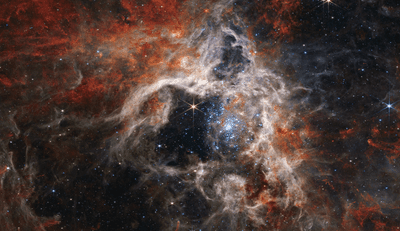


In the Large Magellanic Cloud, the Milky Way's biggest galactic companion, there’s a well-known star-forming region called 30 Doradus or, more commonly, the Tarantula Nebula. JWST has now delivered its first observations of the cosmic region and they are outstanding.
The nebula has a very primitive composition, hardly polluted by the heavy elements that make our planet and even us. Studying it is a window into how stars formed in the distant past without having to look that far away into the universe. At only 161,000 light-years away from us, its (relative) proximity allows us to study the process of star formation in exquisite detail.
The center of the nebula has been cleared of gas by the bright blue cluster of stars to the right of the center. More blue stars are visible in the clearing (as well as red distant galaxies in the background). The blue stars are young and emit a lot of light and stellar winds, carving the structures we can see in the nebula.
JWST sees the universe in infrared light, which can pass through cosmic gas and dust more easily, which means it is capable of penetrating deeper into the cosmos than a telescope using visible light. And indeed it does. Within the filaments of gas, the telescope can identify even younger stars that are starting their own process of clearing the pillar, including one still surrounded by a cocoon of dust made of hydrocarbons as well as molecular and atomic hydrogen gas.

Another one of the JWST instruments, which uses slightly longer wavelengths, focused not on the stars but on the gas and dust. In the mid-infrared image, the bright dots are not fully-formed stars but fledgling protostars. It will take time for them to gain mass and become true stars.
Here, JWST has provided us with a detailed look into an environment we have never seen before.