Space and Physics
 PUBLISHED




What you'll discover in this article
- Mercury is shrinking faster than previously thought, and it might have lost up to nearly 19 kilometers (12 miles) in radius.
- This has several important implications for the interior of this planet.
- “This result suggests that Mercury has less light element[s] in the core,” lead author Gaku Nishiyama told IFLScience.
If all the planets are roughly the same age, why is Mercury so wrinkly? It’s not like the other worlds are getting Botox!
It turns out that, just like a raisin, the smallest planet in the Solar System has shrunk. The process is ongoing, and it might be happening faster than we thought.
Planetary scientists knew that Mercury had been shrinking as its interior cooled down. The new analysis suggests that the actual rate of shrinking has been underestimated.
On average, the rate would be more than 2.7 km / billion year.
Gaku Nishiyama
It could be between 10 and 30 percent more, which suggests that the planet’s radius has lost an extra 11 kilometers (6.8 miles) since the planet’s formation, more than previous analysis suggested. In total, it is 38 kilometers (24 miles) smaller in diameter since its birth.
“On average, the rate would be more than 2.7 km / billion year [1.7 miles/Gyr], while this is just a lower bound of the contraction,” lead author Gaku Nishiyama, a planetary scientist at the German Aerospace Center (DLR) Institute of Space Research, told IFLScience.
The cooling of the planet is responsible for the shrinking. The wrinkles, technically called shortening features, are expected to happen everywhere, but the many craters on the surface make such features difficult to spot.
Mercury has got roughly half of the mass of Mars with a third of the volume. It's a dense planet.
It has an incredibly large metal core for its size, which has intrigued scientists. These findings suggest that the interior of Mercury is even weirder than thought.
“This result suggests that Mercury has less light element[s] in the core, [a] larger inner core, and [a] higher initial temperature and so on,” Nishiyama told IFLScience.
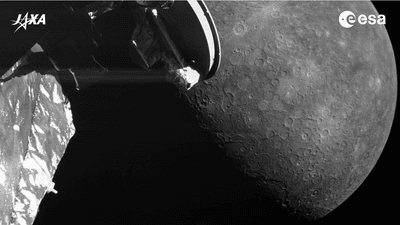
All this work was done using historical data from NASA’s MESSENGER mission which ended in 2015. The European/Japanese mission BepiColombo is just months away from entering orbit around the planet now and will deliver higher resolution data on all these surface features.
“With the BepiColombo Laser Altimeter (BELA), we expect that Mercury's topography can be captured with a better resolution, and then we would be able to get more reliable information on contraction features and roughness. This information will definitely corroborate the findings and may further refine the estimates,” Nishiyama told IFLScience.
The study is published in the journal Geophysical Research Letters.