Space and Physics
 PUBLISHED





What you'll discover in this article
- The underground LZ dark matter experiment has detected a possible particle 200 times the mass of the proton.
- It has only a 2.6-sigma confidence, so it is not considered a discovery of dark matter yet.
- "It could still be an extremely rare background that no one has seen before, but it could also be the first hint of a first dark-matter observation," lead author Sam Eriksen tells IFLScience.
Researchers with the LUX-ZEPLIN (LZ) dark matter experiment have reported a single particle interaction that has made them very excited. It is not a confirmed detection of dark matter yet, but it is one of those data points that can raise the eyebrows of the scientists who see it.
Dark matter is a hypothetical form of matter that should account for 85 percent of all matter in the universe and almost one-third of the mass-energy content. We don't know what it is yet, but we know it exists because it holds mass; however, it does not interact with light, hence the name.
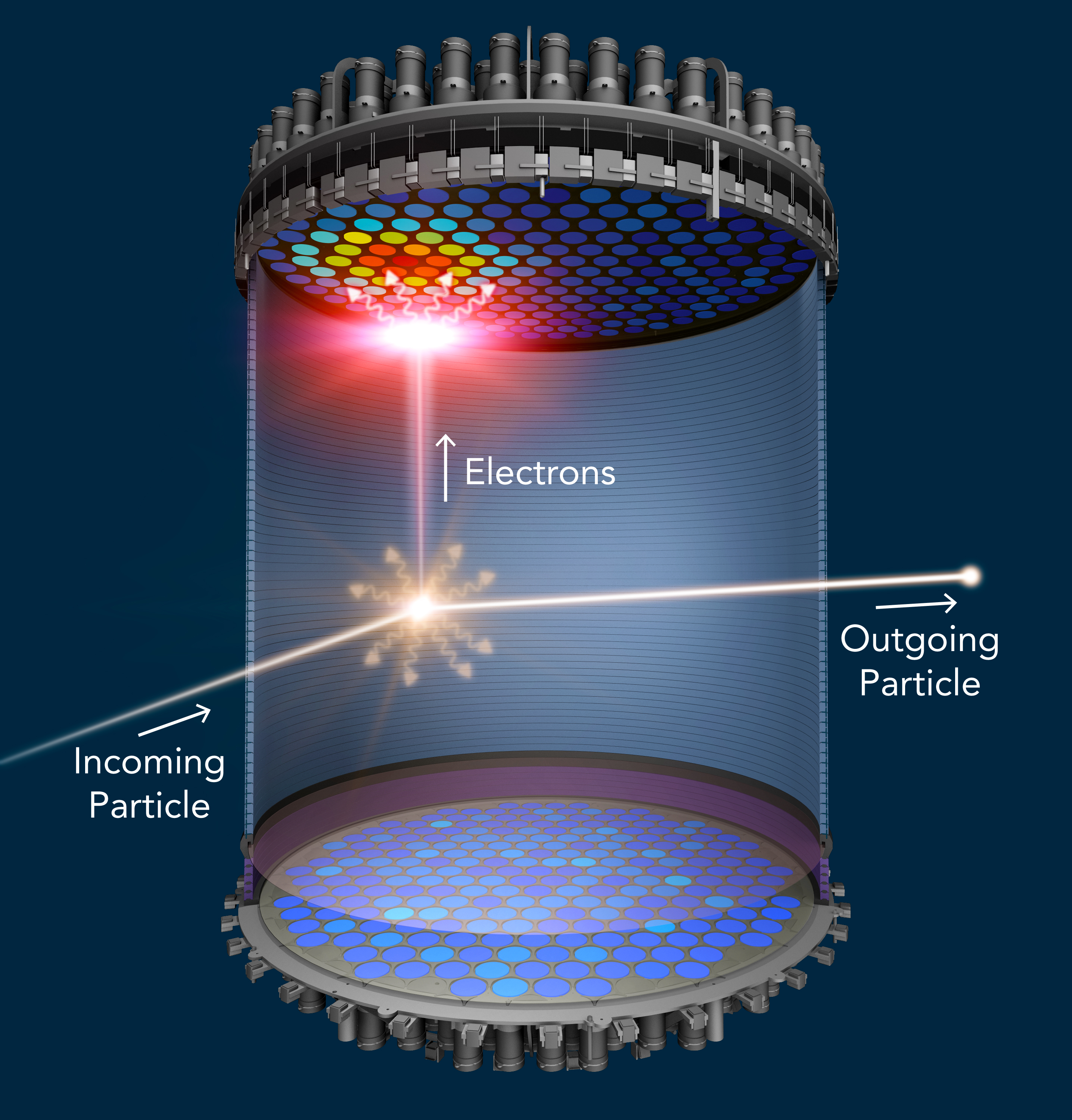
To attempt to detect the elusive particles, the LZ experiment uses a tank filled with ultrapure liquid xenon, located about 1,500 meters (almost a mile) under the Sanford Underground Research Facility (SURF) in South Dakota. The location matters: so deep underground, it is protected from the cosmic rays Earth is bombarded with, which would be a source of noise for the detector.
A leading theory is that dark matter is made of Weakly Interacting Massive Particles, or WIMPs. The particles are heavier than the standard particles that make us, but they would hardly interact with them. Occasionally, WIMPs will hit regular matter, creating a nuclear recoil. This in turn produces light that can be measured by the detector.
That said, there are background events that the team needs to sift through. Natural radioactive events in the environment or in the detector itself could be confused for a signal.
An event worth investigating
The detection, called LZ230616, suggests a particle with a mass more than 200 times that of the proton, and the event happened in a way that no known background event behaves.
“This event that was observed, which we refer to as LZ230616, stands out from the other events,” lead author Sam Eriksen, a senior research associate at the University of Bristol, told IFLScience.
“We observed it in a region of parameter space where the background rate is incredibly low and the event doesn’t act like we expect the backgrounds to. Simply put, this means we may have seen something new."
"One explanation for this is that it’s an ultra rare background, but the other more exciting explanation is that it could be the first indication of dark matter.”
This event has a 2.6 sigma significance, well below the five-sigma gold standard in particle physics. This means that there is a chance of about 1 in 200 that the event is simply from background alone.
You might be thinking that 99.5 percent certainty of this being a new particle is pretty certain, but would you get in a car that could explode once every 200 trips?
A lot more work is needed
The requirement of five sigma is necessary to reach the right confidence level. In other experiments, exciting new particles have disappeared like snow in the Sun once more data was collected. The team is indeed going to collect a lot more data.
We’re putting this result out to the scientific community to get their input on what this event could be.
Sam Eriksen
“This is one event observed in data collected over 370 days. In order to say anything more about this event, or as-yet-unobserved events like it, [we have] to analyse more data which LZ continues to collect,” Eriksen told IFLScience.
“Even within all the data LZ is projected to collect until 2028, dark matter interactions are so rare that we would still only see a handful of events at most. We’re putting this result out to the scientific community to get their input on what this event could be.”
Dark matter has been a leading hypothesis for decades but despite our best efforts, confirming its existence and nature has eluded us.
“We’ve been building progressively larger and more complex detectors, with LZ being the most sensitive to date. In our latest search, we observed an event, which doesn’t appear like any background we know about. It could still be an extremely rare background that no-one has seen before, but it could also be the first hint of a first dark-matter observation,” Eriksen told IFLScience.
A new background event would be very exciting, but if this is the first solid evidence of WIMPs, it would be revolutionary.
The results were presented at the 2026 TeV Particle Astrophysics Conference in Japan by the LZ group at the University of Bristol, funded by the UK Science and Technology Facilities Council.
The study will be released on arXiv and has been submitted to the journal Physical Review Letters.