


 Health and Medicine
 PUBLISHED



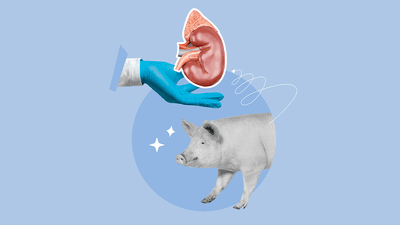


Xenotransplantation – the science of transplanting animal organs into human bodies – has been catapulted out of the realm of science fiction and firmly into the real world.
Since 2024, pig kidneys and a pig liver have been successfully transplanted into living human recipients. Earlier this year, surgery on a deceased individual showed what could be possible in the future by successfully transferring the liver and both kidneys from a pig to a human body.
While historical attempts at cross-species transplants have produced, shall we say, variable results, recent successes have been supported by the emergence of cutting-edge gene editing techniques. It’s now possible for organs to be modified to make them more suitable for humans.
These techniques were used in the pig xenotransplant that Tim Andrews received at Massachusetts General Hospital last year.
The kidney he received had been modified using CRISPR-Cas editing to remove three major antigens that could act as red flags to the human immune system, insert seven human genes, and inactivate endogenous pig virus sequences.
Andrews, who was 66 at the time, had end-stage kidney disease caused by type 2 diabetes. The probability of him receiving a transplant within the next five years was calculated by the team to be around 9 percent. His chances of dying while he waited were calculated at over 40 percent.
This is the sad reality for many patients on the organ transplant waiting list. There simply aren't enough donor organs to go round. “The organ shortage is the greatest crisis we have right now in transplantation,” said lead author Dr Leonardo Riella in a statement.
The US Organ Procurement and Transplantation Network currently estimates that almost 110,000 people are waiting for a donor and that 12 people die each day before they can get a transplant.
Using animal organs instead of human ones in some of those cases is a possibility that scientists are exploring, but there’s another option too: xenotransplants could act as a “bridge to transplant”, keeping patients alive and in better health for much longer until they can eventually get a human organ.
As impressive as xenotransplantation research is becoming, these are still experimental procedures, so getting a human organ remains by far the best option.
This “bridge to transplant” idea is what was explored in Andrews’s case.
271 days dialysis-free, thanks to Wilma
Andrews had been receiving hemodialysis for two years prior to the transplant.
This is where a machine effectively takes over the usual function of the kidneys, filtering waste products out of the blood. It keeps people alive when their kidneys aren’t working, but it’s a very time-consuming process that may even need to be done every day.
Andrews had experienced some side effects and was on the transplant waiting list as no living donor was available. Given his chances of surviving long enough to get a donor match, the team was able to get clearance to try the experimental xenotransplant.
While the actual transplant surgeries have successfully been done before, no previous study has documented a survival time this long, nor has anyone successfully tried the “bridge to transplant” idea.
Andrews’ surgery went well and the pig kidney – which he nicknamed Wilma – began functioning immediately. There was some early evidence of immune rejection, but this was successfully treated.
Incredibly, Andrews was able to come off dialysis for a period of 271 days.
After about six months, there were some signs that the transplant was beginning to fail. Eventually, the pig kidney needed to be removed as its function was declining.
“The doctors had tears in their eyes when they told me Wilma rejected,” Andrews told the National Kidney Foundation. “I said, ‘You don’t have to cry. Be proud of what you did.’ They didn’t reach the moon when the first rocket launched. It took more attempts, more people, more work. That’s what this is.”
However, it was only 82 days later that Andrews underwent transplant surgery again, this time with a human donor organ. In a rare twist of events, the organ turned out to be basically a perfect match for Andrews, something that doesn’t happen all that often.
As of September 1, according to the paper, Andrews’s new organ is still working well 231 days later.
“The case illustrates both the promise and the remaining challenges of clinical kidney xenotrasplantation,” the authors write.
“The xenograft provided sustained dialysis-free kidney function while maintaining key physiological functions, supporting the feasibility of porcine kidneys as a bridging or alternative strategy for patients who lack timely access to human donor organs.”
Andrews's surgery was part of a three-person study, with a second xenotransplant also taking place.
“The patients are the true pioneers here,” said Riella. “By stepping forward and being willing to participate in these early-stage studies, they are advancing the science. Without their trust and courage, we would not be able to do what we do.”
The study is published in The Lancet.




 2
2