Space and Physics
 PUBLISHED
 1
1





In 1968, a book hit the shelves that predicted nothing less than a full-on apocalypse. Called The Population Bomb, it advocated aggressive population control measures: guaranteed abortion rights; abundant contraception; comprehensive sex education; the whole nine yards. Anything less, authors Paul and Anne Ehrlich warned, would result in global famines and environmental damage on a scale humanity simply couldn’t survive.
The rest of this article is behind a paywall. Please sign in or subscribe to access the full content.Of course, as you’re probably aware, that… didn’t happen. Technology moved forward; birth rates dropped pretty much of their own accord; there was an entire third agricultural revolution, even. Which just goes to show: you never can tell what the future holds.
So, when we tell you that a new paper has predicted a potential halving of the global population within the next four decades … maybe don’t panic just yet.
A surprise revelation
If you’re looking for a specialist in human population dynamics, the condensed matter physics department probably isn’t where you’d head. But that’s where Alessio Zaccone, a professor of physics in the University of Milan, found his inspiration for a new paper on just that.
The work, which was jointly undertaken with the late Kostya Trachenko, “originally emerged in the context of condensed matter physics and disordered systems,” Zaccone tells IFLScience, “particularly in our work on stretched-exponential and compressed-exponential relaxation in glasses and complex materials.”
Glass is a weird and confusing thing to study. It’s not a liquid; neither is it really a solid, though it is considered as such for simplicity’s sake. Its molecular structure lacks any kind of order, and the details of how it’s formed are a complete mystery, technically speaking. It behaves… oddly.
As such, it needs an odd physics to describe it. Rather than the standard decay equations, the so-called “stretched-exponential” equation is more useful for describing the relaxation of glass after it’s been perturbed – basically, you take the standard equation, but with the addition of a fractional power that acts to slow down the dynamics.
Even trickier is when your decay somehow progresses much faster than classical physics would predict – a phenomenon that surprised the scientists who discovered it for the first time in 2012.
It was this phenomenon – how and why it occurs, and what it looks like when it does – that Trachenko and Zaccone explored back in 2021, eventually figuring out a unified equation to describe both stretched exponential dynamics and its opposite, compressed exponential dynamics.
The same nonlinear equation is able to describe all the global population growth regimes encountered since the Neolithic until now.
Alessio Zaccone
So far, so physical. But a chance encounter with a 2025 paper from a couple of physicists and an economist in Poland sparked a realization that took Trachenko and Zaccone way out of their wheelhouse:
“Sojecka and Drozd-Rzoska […] were the first to recognize that various historic growth regimes in the global population growth over the past 200 years are described by functions of the type exp(t/τ)^b, where t is time, τ is a characteristic time-frame of the historic period described by the function, and b is a number that can be larger than 1 or smaller than 1,” Zaccone tells IFLScience.
“Exactly the same function provides an excellent approximate solution to […] macroscopic physical properties of glasses, just with the [sign] reversed.”
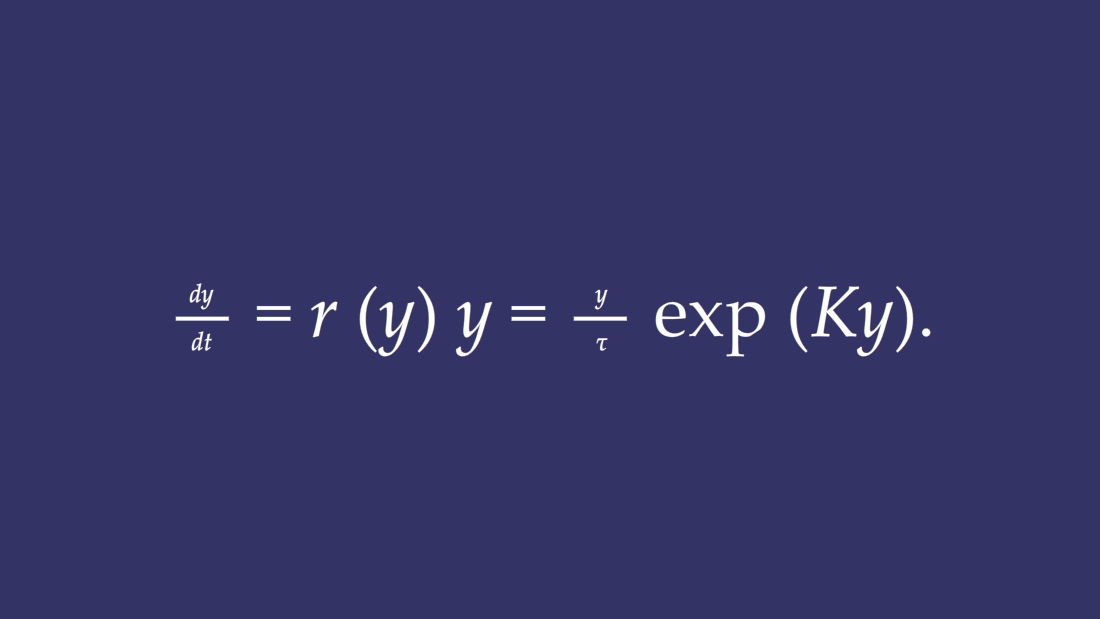
Just how well did this equation describe population dynamics? You’d be surprised: after accounting for factors like birth and death rates, and how they interact with resources and the environment, “we came up with a global population balance equation that is able to recover all the previously known models,” says Zaccone.
“More importantly, the same nonlinear equation is able to describe all the global population growth regimes encountered since the Neolithic until now.”
Doomsdays and naysays
There are, almost without doubt, going to be a few tabloid-worthy headlines associated with this paper. To an extent, that’s understandable – statements like “the global population could be cut in half by 2064” kind of lend themselves to block capitals, after all.
But as legitimate a conclusion as that is from the equation, the pair are keen to stress that it’s a possibility, not a prediction. Not only that, but it’s a purposefully pessimistic one:
“It is a deliberately conservative worst-case mathematical scenario intended to explore what could happen if strong carrying-capacity constraints and severe environmental stressors were to become dominant globally within the next couple of years,” Zaccone says. “In other words, it is better understood as a ‘stress test’ of the dynamics than as a literal prediction.”
Indeed, a closer reading of the paper makes this clear: while the equation can replicate quite closely population dynamics across periods wide and narrow, from the modern day to centuries and even millennia past, it doesn’t tend to do so all at the same time.
“That is an important point,” Zaccone tells IFLScience. “We explicitly state in the paper that different historical intervals are associated with different effective dynamical regimes (hence in different empirical values of K for different historical periods) rather than one single fixed parameterization over all 12,000 years.”
It makes sense – after all, we live in a very different world than our forebears 3,000, 300, or even 30 years ago.
There is, therefore, quite a lot of nuance tied up into that one parameter: K “does not correspond to a single measurable quantity,” Zaccone explains, “but rather encapsulates the aggregate effect of many interacting processes influencing population growth, including […] resource availability, environmental carrying capacity, technological adaptation, energy availability, pandemics, geopolitical instability, fertility changes, and broader societal resilience.”
Just as the Ehrlichs couldn’t foresee the transformations the world would undergo in their own futures, it’s impossible for us to predict exactly how those factors will change in the future. The “doomsday”-like scenarios of population collapse in 40 or 50 years are, Zaccone assures us, not certainties. They’re not even necessarily likely. They’re just… possible.
“Personally, I do not view such an extreme outcome as the most likely scenario,” says Zaccone. “However, studying extreme scenarios is scientifically useful because nonlinear systems can sometimes respond abruptly once critical thresholds are crossed.”
“Typically, it is then very difficult to ‘go back’ and rewind.”
Lessons for study
While the ability to unify hundreds of years’ worth of study into population dynamics with a single equation is no doubt impressive, it’s perhaps not the most important result of the paper.
Rather, the main lesson is more meta: “the paper is about understanding coupled human-environment systems as complex dynamical systems,” Zaccone says. “An important message of our paper is that the time-evolution of the global population is much more ‘nonlinear’, hence potentially unstable, than stipulated by previous models.”
One thing that interests me personally is the possibility that very different complex systems may share common mathematical structures despite having completely different microscopic ingredients.
Alessio Zaccone
Equally significant is the demonstration of that most beautiful of phenomena: the unreasonable efficiency of math. Why should it be the case that an equation from condensed matter physics can describe thousands of years of human population dynamics? How are the two fields connected? Perhaps most intriguingly, what other strange connections are out there, just waiting for the right researcher to find them?
“One thing that interests me personally is the possibility that very different complex systems may share common mathematical structures despite having completely different microscopic ingredients,” Zaccone tells IFLScience.
“Physics has developed powerful tools for studying systems with many interacting components, and I think many of these ideas can be useful well beyond traditional physics,” he says.
“Examples include nonlinear dynamics, critical phenomena, collective behavior, network theory, stochastic processes, and non-equilibrium statistical mechanics. These frameworks are increasingly relevant for understanding epidemics, AI, climate risk, social instability, information propagation, financial systems, and technological transitions.”
The study is published in the journal Chaos, Solitons & Fractals.