Space and Physics
 PUBLISHED
 4
4


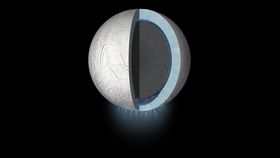


Saturn’s moon Enceladus has a deep ocean hidden below a thick icy exterior. Observations conducted by the Cassini spacecraft have tantalized us about what lies beneath, but we are still unsure if the world could be habitable. Now, new research hints that it might be.
Cassini has found evidence of geothermal activity on Enceladus by studying the molecules released by the moon in plumes. The new model, developed at the Southwest Research Institute (SwRI), estimated abundance of hydrogen and carbon dioxide in the ocean from these plumes to construct a global view of what happens on Enceladus' ocean floor.
As reported in Geophysical Research Letters, the team thinks that the bottom of the ocean is composed of sedimentary rocks (think of something like limestone) rich in carbonate minerals. Below them, serpentine minerals rich in iron and magnesium have formed from igneous rocks – those formed from molten materials like magma.
“By understanding the composition of the plume, we can learn about what the ocean is like, how it got to be this way and whether it provides environments where life as we know it could survive,” lead author Dr Christopher Glein of the SwRI said in a statement. “We came up with a new technique for analyzing the plume composition to estimate the concentration of dissolved CO2 in the ocean. This enabled modeling to probe deeper interior processes.”
This model provides a picture complementary to what we already believe the ocean to be like. Hydrothermal vents on the ocean floor combined with these minerals allow for intriguing chemistry, which can be conducive to life.
“The dynamic interface of a complex core and seawater could potentially create energy sources that might support life,” said the SwRI’s Dr Hunter Waite, principal investigator of Cassini’s Ion Neutral Mass Spectrometer (INMS). “While we have not found evidence of the presence of microbial life in the ocean of Enceladus, the growing evidence for chemical disequilibrium offers a tantalizing hint that habitable conditions could exist beneath the moon’s icy crust.”
Habitability doesn’t mean that Enceladus is inhabited. For now, the answer to the question “is there life on Enceladus?” continues to be a strong "maybe".