Humans
 PUBLISHED


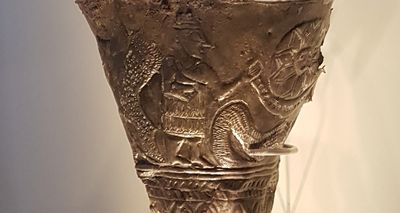


An engraving on an ancient silver cup from the West Bank may represent the oldest known illustration of the creation of the cosmos. The item, known as the ˁAin Samiya goblet, was discovered in 1970 in the tomb of a high-ranking Bronze-Age individual who resided in the Judean Hills, and may have been interred to facilitate the rebirth of this unknown person’s soul.
The rest of this article is behind a paywall. Please sign in or subscribe to access the full content.Standing at 8 centimeters tall (3.1 inches), the 4,300-year-old silver object is adorned with two contrasting scenes, the first of which appears to show a world of chaos ruled over by a serpent. Describing this primordial mayhem, the authors of a new study explain that the illustration depicts a time “when heaven and earth, animals, and plants were fused together so that they could not develop their potential”.
In the next scene, however, the snake lies on the floor defeated, while two human-like figures appear to hold aloft the Sun, bringing order to the universe. Previous interpretations of these engravings have suggested that they may represent a Babylonian creation myth called Enuma Elish, in which a god named Marduk defeats a supernatural agent of chaos called Tiamat in an almighty battle.
However, the authors of the new paper contest this reading, insisting that “the ˁAin Samiya goblet does not depict scenes from the Enuma Elish, as the goblet predates the Babylonian creation myth by more than a millennium and is notably devoid of violent imagery.” They therefore propose that the cosmogonic event engraved on the goblet represents an even older creation myth that synthesizes elements of various legends from across ancient Mesopotamia.
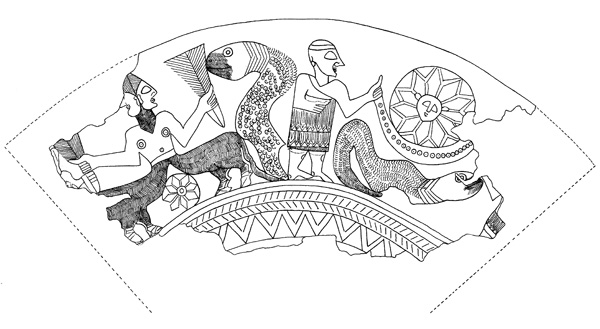
For instance, they point out that the image of the humans holding up the Sun mirrors a similar motif known as the Celestial Boat, which appears on 11,500-year-old pottery from Göbekli Tepe in Turkiye. The researchers therefore propose that the engravings on the ˁAin Samiya goblet depict the world’s oldest known creation myth, which is also found on an artifact called the Lidar Höyük prism.
Discovered in southeast Turkiye, the prism features a series of scenes that tell the story of how the universe came into being when order prevailed over chaos, allowing previously fused forms to separate. Thought to be among the earliest cosmological illustrations in the world, the relic is notable for its depiction of the Celestial Boat.
According to the researchers, the narrative presented on the ˁAin Samiya goblet has more in common with that featured on the Lidar Höyük prism than with the Enuma Elish. If true, that would place the cosmic genesis story found on the silver cup as amongst the oldest in the world.
The study has been published in the Journal of the Ancient Near Eastern Society “Ex Oriente Lux”.