Nature
 PUBLISHED
 3
3


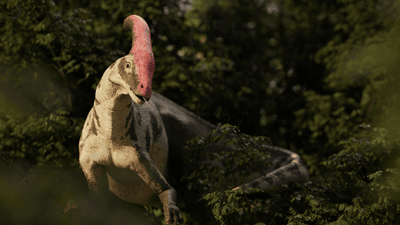


How do you work out what an extinct animal sounded like? One place we can look to is their fossils, and a new research project has set out to do just that for Parasaurolophus, creating a set of pipes they’ve nicknamed the “linophone" inspired by chambers in its skull.
The name comes after its creator, Hongjun Lin from New York University, who has created a physical setup made of tubes to represent a mathematical model that could reveal what was happening acoustically inside the bizarre crest of these dinosaurs.
Parasaurolophus's sound should be relatively low
Hongjun Lin
To test it out, the physical model, based on the resonance chambers in a Parasaurolophus skull, was suspended using threads and excited by a small speaker so that a mic could pick up the frequency data.
“The apparatus linophone is a physical representation of the mathematical model in order to verify the model experimentally,” Lin told IFLScience. “The results show that it best amplifies frequencies at around 581 Hz, 827 Hz, and 1056 Hz, which implies that Parasaurolophus's sound should be relatively low (and that aligns with the conclusions from previous paleontological studies). Linophone is at a 1:1.5 scale to an adult Parasaurolophus crest, so we expect an even lower spectrum of a real dinosaur's voice.”
An adult Parasaurolophus was a sizable beast, at around 4.9 meters (16 feet) tall and up to 3,629 kilograms (8,000 pounds). They were duck-billed giants that lived between 70 to 80 million years ago, but we could soon hear an approximation of their singing in the modern era.

The project reads a bit like the plot to Jurassic Park III, and that’s no coincidence. Lin was inspired to embark on the project after learning that the noises for dinosaurs used in famous films like Jurassic Park were made up from a mishmash of animal noises, including the sound of a mating tortoise.
Lin presented the results on the acoustic characteristics of a physical model of Parasaurolophus' crest at the virtual 187th Meeting of the Acoustical Society of America, running November 18-22, 2024. The project is still in progress, but there could be some exciting musical collaborations in its future.
We'll have a chance to listen to the actual sound of a dinosaur in 21st century.
Hongjun Lin
“When I have the linophone model ready, I plan to convert it into a VST plugin," Lin told IFLScience, "so musicians can have Parasaurolophus sing in their music.”
It's Lin’s ultimate goal to recreate the sound of Parasaurolophus, but for now the linophone represents a well-established starting point. The hope is that if better preserved fossils are found in the coming years, it can be updated, and if that happens, “We'll have a chance to listen to the actual sound of a dinosaur in 21st century,” said Lin.
“I hope my project inspires people to explore the fascinating world of acoustics more deeply, whether through scientific inquiry, creative applications, or simply appreciating the complexity of sound in the natural world.”
The study was presented as part of the virtual 187th Meeting of the Acoustical Society of America.