Space and Physics
 PUBLISHED



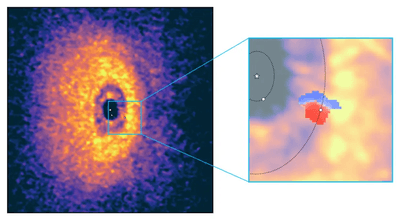


An new set of observations has revealed the swirling gas around a still-growing exoplanet for the first time.
The system is called WISPIT 2, it is 430 light-years from Earth and contains two stars that orbit very close to one another. The stars are surrounded by a protoplanetary disk – the rotating cloud of material in young star systems that later coalesces into planets – and in that disk, astronomers found evidence for two planets.
The first planet, WISPIT 2b, was discovered in 2025. It is five times the mass of Jupiter and sits about twice as far from the system's stars as Neptune does from our sun. By accumulating material, it has carved a gap in the protoplanetary disk. Its sibling WISPIT 2c has only carved a smaller cavity.
This isn't the first time a planet has been caught in the formative moments of its growth. The famous Jupiter-sized planet seen forming around dwarf star PDS 70 precedes it by many years. But WISPIT 2b has a claim to another first.
Thanks to the Atacama Large Millimeter/submillimeter Array (ALMA) observatory, an enormous radio telescope system in Chile, WISPIT 2 is the only star system where we see the protoplanetary disk, evidence that the planet is growing, and the very swirls of gas falling onto the planet all in the same place.
"We clearly see both planets shaping their environment. WISPIT 2c has carved a cavity, and WISPIT 2b a gap," lead author Myriam Benisty, from the Max Planck Institute for Astronomy, said in a statement.
"Around WISPIT 2b, we find swirls of gas that had been predicted by simulations of disk-planet interactions, but never actually seen before. Now there is an image of them!”
The swirling gas appears as a series of pixels that might not appear spectacular to the untrained eye, but to the researchers, they represent a phenomenal feat. At over 400 light-years away, they say, getting this amount of detail is like a person being able to read a book at a distance of 5 kilometers (3 miles).
This work is an important step in understanding an unsolved aspect of protoplanetary disks: are these swirls of gas always associated with planet-formation or are they not? There is a lot of debate in the community because similar swirls have been seen elsewhere in systems where we don't yet have evidence of any planets.
In these cases it could be that there is an unseen planet driving the swirls that we have yet to spot. Alternatively, these swirls might just turn up in particularly turbulent disks, and so can't be used as indicators of a planet's presence.
“Hopefully, observations like this will teach astronomers to distinguish between disk features that indicate the presence of a protoplanet and features that don’t,” added Stefano Facchini, leader of the ALMA observation proposal that yielded the new results.
Next-generation observatories like the Extremely Large Telescope and the Giant Magellan Telescope, combined with the expected upgrade of ALMA, will look for signs of swirling gas in regions much closer to the central star than WISPIT 2b, the researchers said.
A paper describing the work was accepted for publication in The Astrophysical Journal Letters, and it is available on the ArXiv.