Space and Physics
 PUBLISHED



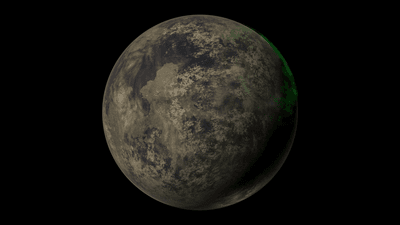


Back in 2024, astronomers discovered an exoplanet around red dwarf GJ 3378. The star is less than a third the mass and a third the radius of our Sun, and it's generally cool and quiet. The exoplanet, GJ 3378b, was previously considered too big to be a target in the search for life. Now observations have revised this, but it isn't all good news.
Originally, GJ 3378b was estimated to be 5.26 Earth masses, making it a sub-Neptune or super-Earth. It was also thought to take just under 25 days to travel around its star, placing it well inside the habitable zone, where the planetary temperature is acceptable for water to exist in a liquid form.
In fact, the planet sits in the conservative habitable zone, a narrower band with stricter requirements in terms of physics and climate stability. This zone doesn't, for example, allow for worlds that were potentially habitable in the past, like Venus or Mars. Still, such a large planet might not have the right conditions for life even if the temperature is right.
New observations now report that GJ 3378b could be a better bet than previously thought. Revised estimates have reduced its mass to about 2.3 Earth masses, still much larger than our planet, but now a lot more likely to have a rocky composition.
Adding to that, the equilibrium temperature (based only on the starlight it gets without any contribution from its potential atmosphere) is just under 0 °C (32 °F), making it an excellent candidate.
"GJ 3378 b is therefore among the most potentially Earth-like exoplanets known within the 10 pc [32 light years] solar neighborhood,” the authors wrote in the research paper.
It isn't all good news for GJ 3378 b, though. The revision also brings the planet closer to its star, orbiting in about 21.45 days. This keeps it in the conservative habitable zone but places it into a potentially dangerous area: the cosmic shoreline.
Now, hearing that expression, you might be thinking of the beautiful cosmic cliffs captured by JWST or a sci-fi holiday planet with incredible views of the universe. It is actually a beautiful turn of phrase for something far deadlier.
Stars are constantly releasing winds of particles and, on occasions, pump out even more dramatic ejections. Red dwarfs tend to be more active in this respect, and these processes can erode a planet’s atmosphere, as has happened to Mars.
The cosmic shoreline is the boundary that divides planets capable of retaining an atmosphere from planets that cannot. This depends on the amount of starlight but also on the planet’s gravity. The revised estimates for GJ 3378b place it significantly closer to this threshold.
Follow-up observations will be necessary to learn more about this exciting planet, and we might soon have the tools for finding many more potentially habitable worlds in our solar neighborhood.
A paper describing the findings was published in The Astrophysical Journal.