Humans
 PUBLISHED
 2
2


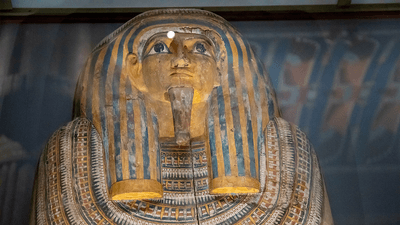


In the 1990s, one team of researchers believed that they had found traces of cocaine, nicotine, and THC within the bodies of ancient Egyptian mummies, long before anyone was thought to have traveled to South America. So how did it get there?
The rest of this article is behind a paywall. Please sign in or subscribe to access the full content.Cocaine, derived from the leaves of two coca species native to South America, has likely been used by local populations for thousands of years.
"The Inca population considered it a miraculous and magical plant that had the power to take away hunger and thirst, produced exhilarating effects, could be used as medicine (as antiseptic and analgesic, to help in digestion, to cure asthma, stomach ache, chest pain and sores, reduce nose bleeding and vomit), and induced a sense of well-being," a paper on the topic explains, adding that the Inca believed that the plant could also preserve bodies, given the numbing effect it has on the tongue.
"The Spaniards showed little interest in coca leaves up until later when they understood their immense commercial value; indeed, they began to financially prosper from Erythroxylum spp. by managing the production and commerce of the plant into the New World."
The plants aren't thought to have made their way over to Europe and the rest of the world until they were brought over by Spanish colonizers. But in 1992, a short and controversial study claimed to have found evidence of cocaine use – as well as tobacco, and potentially cannabis – in the soft tissue, hair, and bones of ancient Egyptian mummies.
In that initial study, German toxicologist Svetlana Balabanova and colleagues tested material from one complete mummy, seven mummified heads, and an incomplete adult mummy, spanning from 1070 BCE to 395 CE. According to the team, they found cannabis and THC in all nine bodies, and nicotine in eight. This was far from the last trace of the drugs that Balabanova and others would find, despite robust skepticism and criticism from archaeologists.
"Balabanova’s team found drugs everywhere, in ancient burials from four continents, in about half of almost a thousand mummies and skeletons analysed, and several results belong to the category of ‘impossible’ findings from an ethnobotanical point of view," ethnobotanist and independent researcher Giorgio Samorini explains in a paper. "To justify the ‘impossible’ findings, Balabanova proposed ever more daring solutions, in an ever more certain and stubborn manner, paralleling the growing volume of criticisms raised by other scholars."
This included the suggestion that ancient Egyptians conducted trans-Atlantic voyages for well over a millennium, trading with the inhabitants of ancient Peru. If it were the case that ancient Egyptians had been found to be using coca plants, it would be a highly significant find. But it is far out of line with what we know of ancient Egyptians, and is distinctly lacking in supporting evidence. In other analyses of ancient mummies performed by other teams, whilst some found evidence of nicotine, they failed to find traces of cocaine or THC.
So, how did these seemingly impossible drugs end up in samples of ancient Egyptian mummies? Had Balabanova found a tight, but millennia-spanning, clique of party mummies?
One idea proposed was that the team had analyzed fake mummies, made of modern-day drug users. However, this was deemed to be unlikely by other archaeologists, including the Keeper of Egyptology at the Manchester Museum, looking into the same mummies.
Samorini notes the lack of controls in a lot of Balabanova's work, as well as a neglect of more sophisticated techniques. For example, by taking a hair from a body and then looking at different segments, representing (for example) a month's growth, you can build up an idea of the person's relationship with drugs over time, an analysis not performed by Balabanova.
With others failing to find similar drug levels in other mummies, in all likelihood, the cocaine positives were the result of later contamination. It is known that hair samples from non-users can become contaminated with cocaine, and it is still detectable later on, regardless of washing technique. With cocaine popular long before "proper storage of archaeological finds" became a hit, it is probable that the team found modern cocaine on ancient bodies.
Traces of nicotine are likely not the result of contamination, though we should stress this isn't the part where we tell you that ancient Egyptians nipped over to South America for a bit of baccy rather than coca leaves. Several known European plants contain nicotine, and it is plausible that the ancient Egyptians had ingested them. However, researchers have found few instances of nicotine being converted into cotinine in ancient mummies. Cotinine is considered to be a more reliable indicator of use, as it shows that the drug has been metabolized by the body.
"English scholars have additionally observed how in the 19th century, among the conservation practices of mummies, it was customary to sprinkle them with tobacco dust, as well as pyrethrum, the latter a compound obtained from species of Tanacetum and also identified in the mummy of Ramesses II. Both substances acted as insecticides," Samorini adds.
"This practice was not limited to Egyptian mummies but to numerous other European and Asian mummies, and it is plausibly this conservation technique that gave rise to the discovery of fragments of tobacco and nicotine in the mummy of Ramesses II and of nicotine in the ‘drugged mummies’ of the Balabanova team."
THC, meanwhile, is a little less controversial, with ancient Egyptians thought to use cannabis to treat bladder infections, eye pain, and potentially as a soothing enema. Yes, apparently, ancient Egyptians could have been boofing weed. However, again, other studies have not found THC on mummies, suggesting contamination or poor practices by the initial research team could be to blame for the results.
In short, while stories of ancient Egyptians traveling the ocean to South America to pick up some cocaine and tobacco might sound fun, it is far more likely that they died unaware of the substances they would later be sprinkled with.