Nature
 PUBLISHED





Watch a mess of marine iguanas for a bit and you’ll start to notice them doing something strange. Every now and then one will fire fluid out of its nostrils. They’re not sick; they’re sneezing excess salt from specialized glands, something a fascinating new study suggests Spinosaurus might have done too.
The rest of this article is behind a paywall. Please sign in or subscribe to access the full content.Yes, that Spinosaurus. The dinosaur that so loves to spark delicious debate. Once thought to be a heron-like hunter that lurked near water, evidence of unusually dense bones later convinced some scientists it spent a lot of time submerged and possibly even hunted underwater. Some species had teeth perfect for grasping fish and a paddle-like tail that's been interpreted as swimming apparatus, but there’s something else one has to overcome if you’re going to live and hunt in water: salt.
The problem with swimming
Salt is delicious and vital. It contains the element sodium that’s needed to regulate fluid balance and transmit nerve impulses in animals, but too much can prove deadly. This is why seabirds and some reptiles alive today have specialized salt glands that effectively filter out salt from the blood and get rid of it. It comes in handy when they catch a mouthful of food and get a bellyful of salty water.
Our find is a rare opportunity to link something from the physiology and the ecology.
Andrea Cau
Finding evidence of a gland on a fossil isn’t easy. While soft tissues can be preserved in the fossil record, they are usually the first to go. Still, we can look to fossilized bone for evidence of soft tissues, searching for structures that indicate where glands and ducts may have attached.
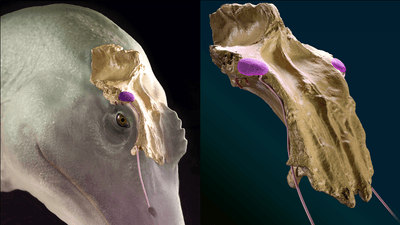
The signs they were looking for in the dinosaur skulls were pathways or depressions that could feasibly have housed a salt gland and its associated drainage duct when the animal was alive. They examined several spinosaurid skulls and compared them against those of living seabirds and marine iguanas.
Searching for salt glands
The strongest anatomical clues were found above the eye in some later-diverging spinosaurines, where the researchers identified structures consistent with the position of a salt gland. It would have sat in a similar position to the salt glands of seabirds, with an excretory duct leading to the nostril.
Usually, we palaeontologists can at most link some elements of the skeleton to some adaptation in the locomotion or some diet specialization, but it's very difficult to reconstruct other features of the extinct biology from the bones alone.
Andrea Cau
This would suggest an example of convergent evolution where the same trait crops up in two unrelated groups. This can happen when animals occupy similar niches (e.g. hunting in water) because they’re trying to find a solution to the same problem – in this case, excess salt.
It could also help explain why Spinosaurus had such a bizarrely shaped head, using clues from its anatomy to better understand its lifestyle.
“Our find is a rare opportunity to link something from the physiology (in this case, the function of the gland and its role in salt regulation) and the ecology (the environment and diet) of an extinct dinosaur,” study author Andrea Cau at the OPHIS Museum of Palaeontology and Center of Herpetology in Italy told IFLScience.
“Usually, we palaeontologists can at most link some elements of the skeleton to some adaptation in the locomotion or some diet specialization, but it's very difficult to reconstruct other features of the extinct biology (like the physiology) from the bones alone.”
Salty at sea
The gland positioning means that, like seabirds, salt excretion probably didn't have any meaningful influence on their appearance. Though, as Cau told IFLScience, we still have no idea what kind of skin covered Spinosaurus’s head, so we know very little of what they truly looked like.
The same cannot be said for that mess of iguanas I mentioned earlier. Marine iguanas sneeze out their salt excretions, but what gets left behind hardens into a white crust that can build up so much it's been nicknamed a “salt wig” or “white hat”.
“It's unlikely that [the salt glands] gave some ‘iguana-like’ external feature to this dinosaur,” said Cau. “Note that in the marine iguana, the glands are inside the skull (they are covered by the head bones), whereas in Spinosaurus the glands were above the skull (they were in depressions above the bones, and in life were covered by the skin: the latter is the same condition as in birds). In both cases, the glands have almost no effect on the life appearance of birds and iguanas.”
Sad, then, that Spinosaurus probably wasn’t rocking a salty hat, but there are much bigger implications. The authors suggest this salt-excretion apparatus could help explain why, to our knowledge, there were no marine or fully aquatic dinosaurs. It's possible that aspects of dinosaur skull anatomy weren’t compatible with efficient salt-excretion systems, so any attempts to occupy aquatic or marine niches were scuppered by the negative effects of too much sodium. In short:
Dinosaurs: Fancy a swim?
Evolution: Na.
The study is published in the journal Historical Biology.